Operating Industrial Wastewater Treatment Plants: Why Outsourcing Is Becoming a Strategic Success Factor
May 6, 2026Why There Really Are Worlds Between Old and New Distillate
In many industrial companies, wastewater technology is only questioned when limit values become critical or operating costs noticeably increase. As long as the plant “runs”, it often remains untouched. But especially with evaporator systems, it becomes clear that there are significant qualitative and economic differences between technology that is 10 to 15 years old and a modern, energy-optimised system.
A current project at an aluminium die-casting company demonstrates this impressively. Within one week, an existing evaporator system was dismantled during ongoing operation, properly disposed of and replaced with a modern system. The result: significantly better distillate quality, substantial energy savings and noticeably reduced operating costs.
This technical article explains the background, the technical classification and the economic effects — and why replacing an evaporator system can be a strategic lever for manufacturing companies.
1. Initial Situation in Aluminium Die Casting: Process Water with High Contamination
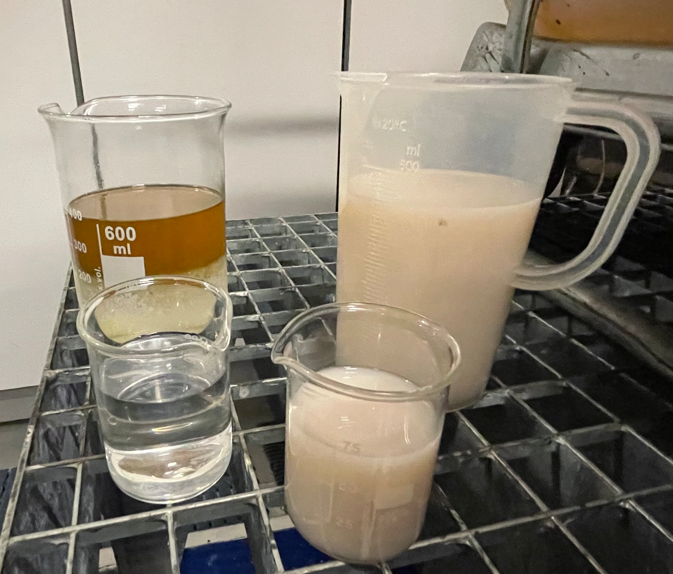
On the right-hand side of the image, a typical sample of non-concentrated process water from an aluminium die-casting process can be seen. Such wastewater is generated, among other things, by:
- Release agent residues
- Cooling lubricants
- Emulsions
- Metal particles
- Cleaning chemicals
Typical parameters:
- High chemical oxygen demand (COD)
- Fluctuating conductivity
- Oil and grease content
- Temperature-dependent viscosity
For many die-casting companies, evaporation is a proven process for volume reduction and easing the burden of disposal. However, the performance of the evaporator technology has a decisive impact on:
- Energy consumption per m³
- Distillate quality
- Disposal volume of the concentrate
- Operating costs
- CO₂ footprint
On the left-hand side of the image, the distillate from the old system can be seen. Even visually, turbidity and residual contamination are apparent. In practice, this meant:
- Increased internal monitoring effort
- Uncertainty regarding discharge values
- Limited potential for water recycling
- Potentially higher post-treatment costs
Although the system formally fulfilled its function, there was a clear need for optimisation in terms of both energy efficiency and quality.
2. Technical Analysis of the Existing System
Before making an investment decision, the existing evaporator system was analysed in detail. As technology- and manufacturer-independent specialists, we assess every system neutrally — both technically and commercially.
Typical weak points of older evaporator systems include:
- Insufficient heat recovery
Energy is not used efficiently within the system. - Constant power consumption
No load-dependent adjustment to fluctuating wastewater volumes. - Outdated control technology
Limited data acquisition and hardly any optimisation options. - Wear-related inefficiency
Deposits and reduced heat transfer. - High specific electricity consumption
In some cases, 60–100 kWh/m³ with unfavourable system design.
Especially in times of rising energy prices, high specific consumption has a major impact on operating costs.
From practical experience, we know that operating cost savings of > 30% are realistic in optimisation projects.
3. The Decision: Replacement Instead of Partial Optimisation
After the technical and economic assessment, it became clear that simply optimising the existing system would only make limited sense.
Decision criteria for complete replacement:
- High specific energy consumption
- Limited distillate quality
- Maintenance-intensive operation
- Lack of expandability
- Limited future viability
The new system was designed to:
- Operate with optimised energy efficiency
- Be controlled according to load
- Deliver consistently high distillate quality
- Be expandable, for example through the integration of intelligent control modules
4. Implementation: Replacement in Record Time
One central challenge was the time factor. The customer could not afford any production downtime.
Within one week:
- The old system was dismantled
- It was properly disposed of
- The new evaporator system was installed
- Hydraulic and electrical connections were made
- The system was commissioned
The entire measure was carried out during regular production operations.
This approach requires:
- Precise advance planning
- Clearly defined interfaces
- An experienced installation team
- Structured commissioning processes
This is where the advantage of an engineering partner with practical operating experience becomes evident.
5. The Result: Distillate Quality on a New Level
The middle sample in the image shows the distillate from the new system. The difference is clear:
- Clear
- Virtually particle-free
- Visually high-quality
- Consistently reproducible
From a technical perspective, this means:
- Low residual COD values
- Lower conductivity
- Reduced residual organic load
- Better suitability for recycling
There really are worlds between the old and new distillate quality.
6. Energy Efficiency: The Economic Lever
In addition to the quality improvement, energy efficiency was the key success factor.
Modern systems enable significant reductions in specific energy consumption compared with existing systems.
The new system works with:
- Optimised heat recovery
- Intelligent process control
- Load-dependent power regulation
- Improved heat transfer
The result:
- Significantly lower electricity consumption
- Reduced CO₂ emissions
- Stable and predictable operating costs
A managing director of a Tier 1 automotive supplier put it perfectly:
“I would never have thought how much cost-saving potential there was in my wastewater treatment plant.”
7. Economic Assessment Over the Life Cycle
When investing in evaporator systems, the purchase price should not be the only factor considered.
What matters most are:
- Energy consumption over 10–15 years
- Maintenance effort
- Spare parts costs
- Disposal costs
- Development of CO₂ costs
It often becomes clear that:
A modern system amortises faster than expected — especially with high wastewater volumes.
In addition, subsidy programmes in the field of CO₂ reduction can be used.
8. Strategic Importance for Industrial Companies
Wastewater technology is often seen as a secondary system. In reality, it is:
- Relevant for permits
- Relevant for costs
- Relevant for sustainability
- Relevant for reputation
An inefficient evaporator system causes:
- Hidden energy costs
- Higher CO₂ emissions
- Technical uncertainties
- Increased maintenance effort
A modern system, on the other hand, creates:
- Planning reliability
- Cost transparency
- Improved environmental performance
- Future viability
9. The Role of smart5: Neutral, Technically Sound and Practice-Oriented
As independent wastewater specialists, we support companies with:
- Technical analysis of existing systems
- Troubleshooting
- Profitability calculations
- Planning of replacement investments
- Engineering, construction and integration
- Support with subsidy applications
Our independence enables us to implement the best solution in each case — without being tied to any manufacturer.
Our guiding principle is:
We clean water and save energy.
10. Conclusion: Rethinking Evaporator Technology
Replacing the old evaporator system has shown:
- A major quality improvement in the distillate
- Significant energy savings
- Considerably reduced operating costs
- Improved CO₂ balance
- Higher operational reliability
The differences between old and modern technology are not only technical — they are also economic.
For many industrial companies, the question is not whether optimisation potential exists, but how great it is.
If you would like to know what savings potential lies within your existing evaporator system, please feel free to contact us without obligation.
You can find our contact form for support and assistance here:
https://smart5-group.com/kontakt/