
Electricity and CO2 savings
July 15, 2022
Operating Industrial Wastewater Treatment Plants: Why Outsourcing Is Becoming a Strategic Success Factor
May 6, 2026
Ultrafiltration of Aluminium Die-Casting Wastewater: Efficient, Sustainable Treatment for High Loads
Aluminium die-casting production is one of the most demanding industries when it comes to industrial wastewater treatment. Foundries generate wastewater that is heavily contaminated with emulsions, oils, metal particles and process chemicals. Many existing systems still operate with outdated technologies, which not only causes high energy and operating costs, but also creates risks when it comes to complying with limit values and environmental regulations.
In view of increasing legal requirements and growing cost pressure, foundries must implement BAT — Best Available Techniques — while continuing to operate economically. The intelligent combination of ultrafiltration and evaporator technology — the basis of the smart5 DieCast solution — offers a decisive advantage over conventional systems.
In this article, we explain how these technologies work, what benefits they offer, how the practical reference at ZF Gusstechnologie confirms this, and why now is the right time for retrofitting or modernisation.

Challenge: Highly Contaminated Wastewater in Aluminium Die-Casting Production
Wastewater from aluminium die-casting processes is among the most difficult industrial wastewater streams of all. It contains:
-
Emulsions from cooling and lubricating agents
-
Hydraulic fluids and process chemicals
-
Metal particles and abrasion residues
-
Organic and inorganic chemicals
This mixture leads to a high organic and inorganic load, which significantly increases both environmental compliance requirements and operating costs. In addition, so-called surcharge fees for high-strength wastewater are often incurred, frequently exceeding €100,000 per year, for example due to excessive COD loads.

Many traditional treatment methods reach their limits here. They are energy-intensive, require large amounts of chemicals and often generate sludge that is difficult to dispose of. At the same time, companies are increasingly facing stricter limit values and monitoring requirements.
The result:
👉 High energy costs
👉 High disposal costs
👉 Operational risks due to limit value exceedances
👉 Uneconomical legacy technology instead of smart, energy-efficient solutions
This is where the smart5 DieCast solution comes in. Further information can be found below.
Link: Aluminium-Druckguss smartDieCast in der Industrie – smart5 group
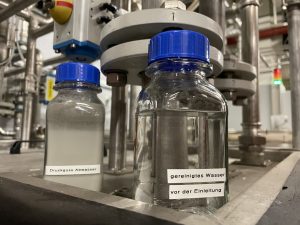
Ultrafiltration of Aluminium Die-Casting Wastewater – How Does Ultrafiltration Work in Detail?
Ultrafiltration (UF) is a membrane process based on physical separation. Unlike chemical flocculation or sedimentation, UF efficiently separates even the finest components — without requiring large amounts of chemicals.
Technical Basics
-
Membrane types: Ceramic membranes, highly resistant with a long service life
-
Pore size: Typically 0.01 to 0.1 µm — separates emulsions, microorganisms, oils and solids
-
Separation mechanism: Pressure-driven filtration, separating retentate from permeate
Ultrafiltration acts like a “fine sieve” at molecular level — reliably and reproducibly removing undissolved particles, emulsions and oil-water mixtures.

Why Ceramic Membranes?
Ceramic membranes offer decisive practical advantages:
✅ Very high thermal and chemical resistance
✅ Long service life — often more than 10 years in practice
✅ Excellent cleanability, even with difficult wastewater
✅ Low cleaning and maintenance requirements
This makes UF ideal for aluminium die-casting wastewater, which often contains varying loads and strong fluctuations.
Leistungsparameter Ultrafiltration:
| Parameter | Application Range |
|---|---|
| Throughput | Up to several m³/h depending on the system |
| Removes | Emulsions, oil, solids down to < 0.1 µm |
| Chemical demand | Minimal |
| Energiebedarf | niedrig im Vergleich zu thermischen Verfahren |
| Membrane material | Ceramic |
The result:
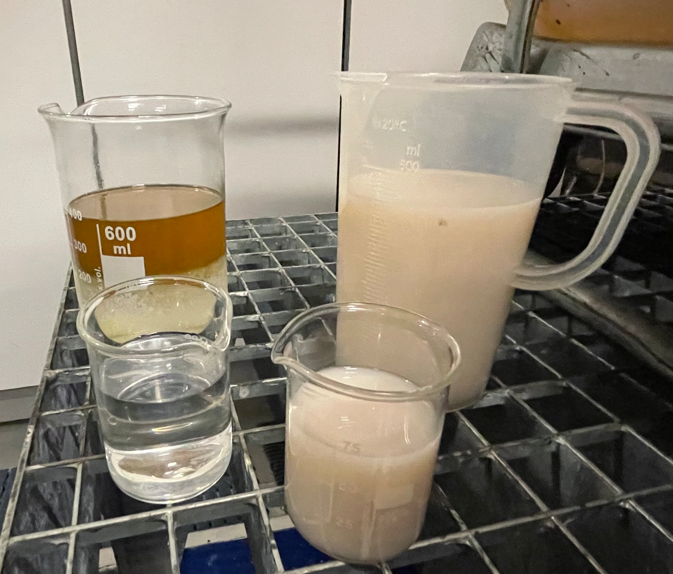
➡️ Significantly cleaner permeate
➡️ Fewer chemicals
➡️ Lower operating costs
➡️ Stable operational reliability
Evaporator Technology: Volume Reduction with Low Energy Demand
Ultrafiltration alone already delivers enormous advantages. However, especially with heavily contaminated wastewater, residual substances still remain in the UF permeate. Another challenge is the high wastewater volume, which causes costs for transport and disposal.
This is where evaporator technology comes into play.
What Does Evaporation Achieve in Wastewater Treatment?
Evaporators drastically reduce wastewater volume by extracting water from the wastewater in the form of vapour. What remains is a concentrated residue that is easy to dispose of. In the smart5 solution, however, only 10% of the wastewater volume is treated using evaporator technology, whether electrically or externally heated, because only the concentrates from the ultrafiltration process are treated.
The technologically decisive factors are:
🔹 Low energy demand, with the combined UF + evaporator system requiring only 8–10 kWh/m³
🔹 The use of vapour compressors or heat pumps for energy optimisation
🔹 High separation efficiency for dissolved substances and residual environmental load
As a result, a large wastewater stream is converted into a significantly smaller, highly concentrated product with minimal disposal volume.
Comparison: Evaporation vs. Conventional Disposal
| Technology | Energy Demand | Disposal Volume | Chemical Demand | Operating Costs |
|---|---|---|---|---|
| Conventional | Low | High | Medium | High |
| Evaporator technology | 8–10 kWh/m³ | Significantly reduced | Low | Low |
Key Advantage:
By combining ultrafiltration and evaporator technology, pollutants are not only reliably removed — the volume requiring disposal is also dramatically reduced. This saves disposal costs, minimises environmental impact and makes the system economical.
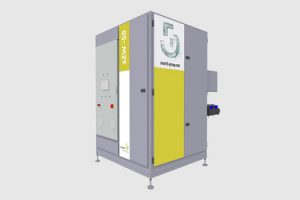
Various evaporator and vacuum evaporator systems are also available as test or rental units.
BAT – Best Available Techniques: Obligation, Opportunity and Competitive Advantage
In industrial wastewater treatment, compliance with BAT — Best Available Techniques — has long been more than just a legal obligation. For companies, it is becoming a strategic advantage.
Why BAT Is Crucial Today
✅ Compliance with legal limit values: Environmental regulations are becoming stricter — BAT creates legal certainty
✅ Sustainable and energy-efficient: BAT means conserving resources and reducing costs
✅ Competitive advantage: Environmental certificates and green production become customer benefits
✅ Operational reliability: Modern technology minimises downtime risks and maintenance effort
Especially in the aluminium foundry industry, with its complex wastewater profiles, BAT is a decisive factor for long-term competitiveness.
smart5 DieCast Solution: Ultrafiltration + Evaporator Technology Working Together
The combination of ultrafiltration and evaporator technology is more than the sum of its parts. It creates an integrated, powerful and economical system for aluminium die-casting wastewater treatment.
Core Principles of the smart5 Solution
-
Pre-treatment and separation: Removal of coarse substances and oils
-
Ultrafiltration: Fine filtration of emulsions, solids and micro-contaminants
-
Evaporation: Volume reduction and concentration of residual substances
-
Return of cleaned streams: Reduced disposal and potential for reuse
The result:
-
Virtually no chemicals in the process
-
Low operating costs in €/m³
-
Minimised disposal
-
High operational reliability
-
BAT-compliant and sustainable
Our solution has a modular design and can be retrofitted into existing systems or integrated into new installations — ideal, for example, for aluminium die-casting applications.

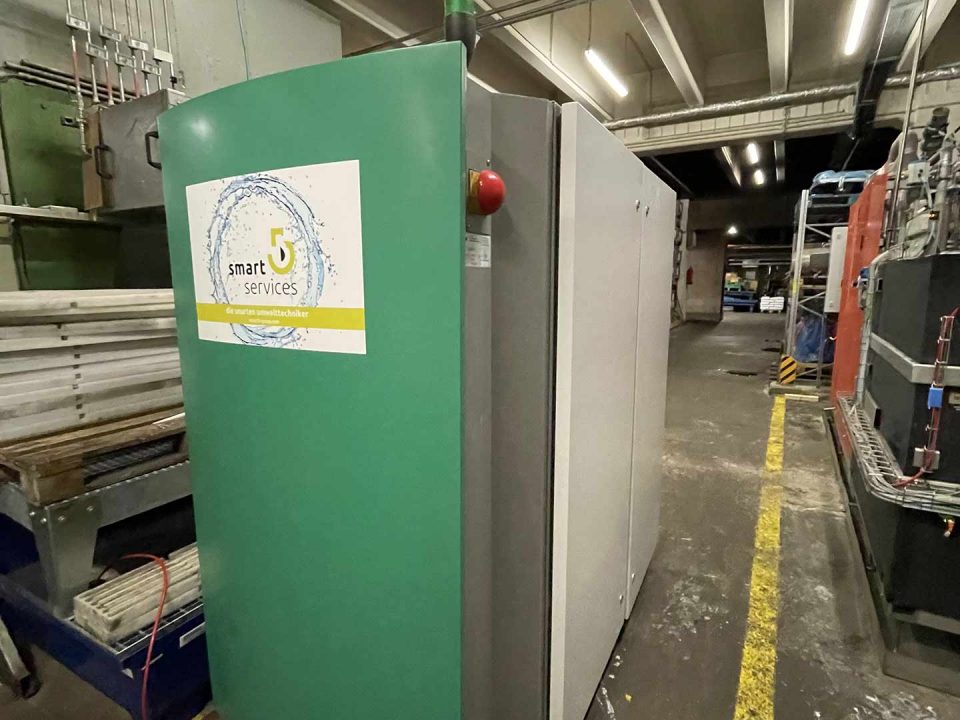
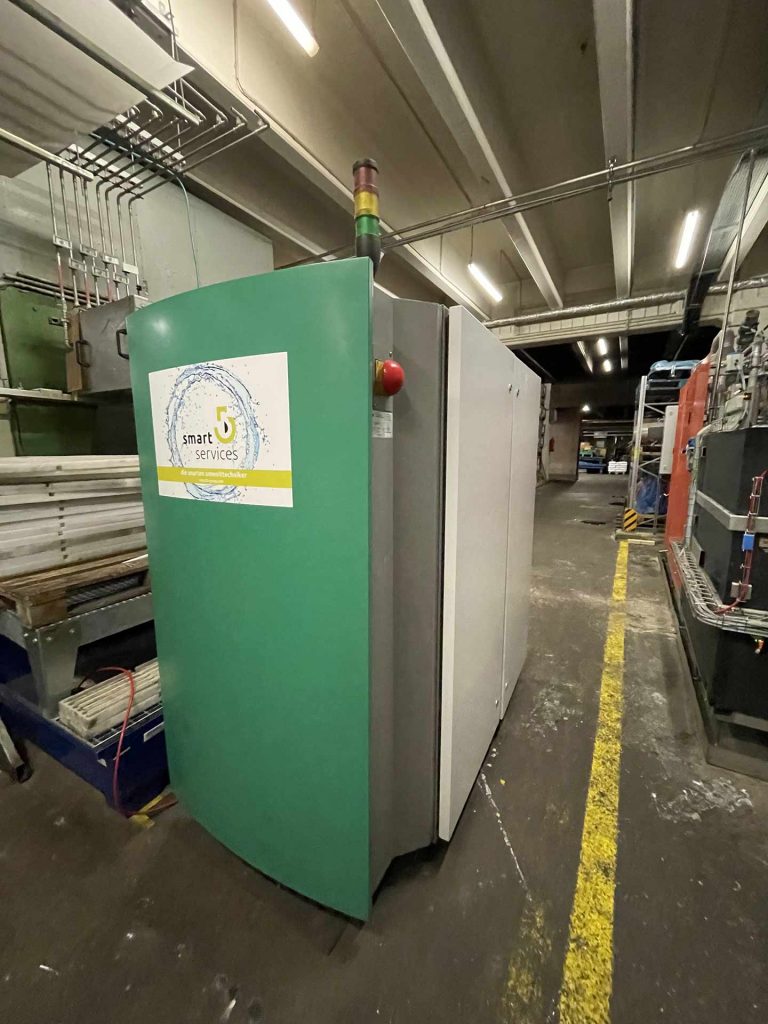
A system can, for example, be configured as follows:

The data sheet can be found here:
smart5_Einzelprospekt-sDC1000-10000.indd
Practical Reference: Ultrafiltration and Evaporator Technology at ZF Gusstechnologie
A practical example shows what is possible today: the reference system at ZF Gusstechnologie has been running faultlessly for more than 18,000 operating hours.
➡️ An ultrafiltration system with a capacity of 7,000 l/h continuously processes heavily contaminated wastewater from aluminium die-casting processes — and has done so for almost 3 years without incidents.
This application proves:
✔ Reliability in continuous operation
✔ Minimal maintenance
✔ Stable permeate quality
✔ High operational reliability
The economic effects are impressive:
📉 Reduced operating costs
📉 Lower disposal expenses
📈 High process stability
📈 Sustainable wastewater treatment
This reference project clearly shows that smart5 technology works under tough industrial conditions.

Statements from the smart5 Management
Jochen Holz, Managing Director:
“We have been successfully optimising and operating plant technology in the field of aluminium die casting for years and are absolute wastewater specialists in this area.”
Frank Schlegel, Managing Director:
“I am convinced that, with our concept and process management for treatment using ultrafiltration and waste minimisation through evaporator technology, we have the best concept on the market.”
These statements reflect the company’s technical self-image and strategic focus: efficient, sustainable and economical solutions for demanding wastewater problems.
Step by Step: How to Make Your Wastewater Treatment System More Efficient
Many companies know that their technology needs to be modernised. But what does the operational path look like?
Step 1: Analysis of the Current Situation
📌 Wastewater load profile, including hydraulic oils, solids, COD, etc.
📌 Throughput volumes
📌 Existing plant technology
📌 Limit values and permit requirements
Step 2: Concept Development
🔹 Selection of suitable UF modules
🔹 Dimensioning of the evaporator technology
🔹 Chemical concept, if required
🔹 Integration into existing processes
Step 3: Installation and Commissioning
📌 Delivery, setup and installation of the plant technology
📌 Commissioning of the ultrafiltration and evaporator technology
📌 Automation and process control
Step 4: Optimisation and Monitoring
✅ Online monitoring of important parameters
✅ Adjustment of process control
✅ Regular maintenance and membrane inspection
Step 5: Reporting and Quality Assurance
📌 Documentation for authorities
📌 Proof of BAT compliance
📌 Sustainability indicators
Economic Effects and Savings Potential
The combination of UF and evaporator technology has enormous economic effects. Our analyses show that many foundries can achieve:
📊 Savings potential of several hundred thousand euros per year
— without new construction, solely through intelligent retrofitting of existing systems.
Key Influencing Factors:
🔹 Energy savings compared with thermal processes
🔹 Reduced demand for chemicals and auxiliary materials
🔹 Lower disposal costs
🔹 Minimised downtime
🔹 Greater legal certainty
The bottom line: operating costs decrease, environmental performance improves and operational reliability increases.

Sustainability: Conserving Resources and Protecting the Environment
Sustainability is not a nice-to-have — it is an economic necessity. The smart5 solution contributes to:
🌱 Reduction of fresh water consumption
🌱 Minimisation of sludge and residues
🌱 Lower CO₂ emissions through efficient energy use
🌱 Compliance with strict environmental regulations
This not only ensures compliance, but also contributes to corporate environmental responsibility.
Figures and Key Performance Indicators: What the Technology Delivers
| Key Figure | Value |
|---|---|
| UF membrane service life | Up to 12 years |
| Energy demand UF + evaporator | 8–10 kWh/m³ |
| Reference throughput ZF Gusstechnologie | 7,000 l/h |
| Reference operating hours | >18,000 hours |
| Average savings potential | Several hundred thousand euros per year compared, for example, with vacuum evaporator solutions |
These values show that ultrafiltration and evaporator technology are not visions of the future — they are stable, high-performance industrial processes available today with clear efficiency advantages.
smart5 at Euroguss 2026 – Meet Us in Person!
We look forward to presenting our solutions to you at Euroguss 2026 in Nuremberg:
📍 Hall 5, Stand 5-148
📅 13–15 January 2026
Use the trade fair to:
🔹 Speak directly with our wastewater experts
🔹 Experience practical solutions live
🔹 Discuss your individual requirements
👉 Visit us at Euroguss 2026 — we look forward to expert discussions and new ideas!
EUROGUSS | International Trade Fair for Die Casting: Technology, Processes, Products

In May, we will also be exhibiting at IFAT Munich 2026, the world’s leading trade fair for environmental technologies:
IFAT Munich 2026 – World’s Leading Trade Fair for Environmental Technologies

Conclusion: Ultrafiltration for Aluminium Die-Casting Wastewater – The Smart Solution for High Loads
Industrial wastewater from aluminium die-casting processes places high demands on technology, operation and cost-effectiveness. The combination of ultrafiltration and evaporator technology — as implemented in the smart5 DieCast solution — provides:
✔ Sustainable, energy-efficient treatment
✔ Compliance with BAT standards
✔ Massive cost savings
✔ High operational reliability
✔ Low environmental impact
The successful reference at ZF Gusstechnologie proves that the technology works under harsh industrial conditions — reliably over many years.

👉 Would you like to know what potential lies in your wastewater treatment system and how you can optimise your processes?
➡️ Contact us via our contact form:
https://smart5 group.com/kontakt
We support you from analysis and planning through to implementation and beyond — technology-independent, efficient and economical.